
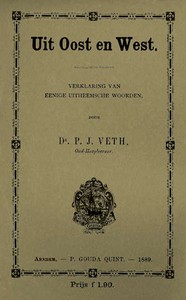
Uit Oost en West: verklaring van eenige uitheemsche woorden by Pieter Johannes Veth
Don't let the formal 19th-century title fool you. 'Uit Oost en West: verklaring van eenige uitheemsche woorden' (From East and West: Explanation of Some Foreign Words) is a charming and curious project. Published in 1875, it's essentially a scholarly pamphlet where linguist Pieter Johannes Veth picks apart dozens of words that had become common in Dutch but originated elsewhere.
The Story
There isn't a plot in the traditional sense. Instead, Veth presents a list. He takes words like 'thee' (tea), 'rijst' (rice), 'orang-oetan', and 'tabak' (tobacco), and for each one, he plays detective. He traces their paths back through languages and across oceans. He shows how 'ketchup' started as 'kecap' in Malay, referring to a fish sauce, and hitched a ride with sailors. He explains how 'bamboo' traveled through Portuguese and Dutch from its origins in Malay or Kannada. Each entry is a mini-story of exploration, trade, and cultural exchange, mostly focused on the Dutch colonial experience in the East Indies.
Why You Should Read It
What makes this old glossary compelling is its perspective. You're seeing the world through the eyes of a 19th-century European scholar trying to make sense of a rapidly globalizing vocabulary. It's a snapshot of a time when these 'exotic' words were still fresh and their origins were a topic of fascination. Reading it today, you get a double history lesson: one about the words themselves, and another about how people in the 1870s understood the world. It turns a simple list into a conversation about connection and curiosity. You start seeing the history of colonialism and global trade hidden in plain sight, in the words we use at the dinner table or while describing the weather.
Final Verdict
This is a niche read, but a delightful one. It's perfect for word nerds, etymology enthusiasts, and history buffs who enjoy primary sources. It's not a cover-to-cover narrative; it's a book to dip into, a piece of linguistic archaeology. If you've ever looked at a word and wondered, 'How did you get here?'—Veth was asking the same question 150 years ago. His little book is a reminder that language is never static; it's always borrowing, adapting, and telling the story of who we've met along the way.
There are no legal restrictions on this material. It is now common property for all to enjoy.
Kimberly Perez
1 year agoRight from the opening paragraph, the logic behind each conclusion is easy to follow and verify. Truly a masterpiece of digital educational material.
Karen Martinez
9 months agoAs someone working in this industry, I found the insights very accurate.
Jennifer Jackson
6 months agoI was skeptical about the depth of this book at first, but the language used is precise without being overly academic or confusing. A rare gem in a sea of mediocre content.
Karen Lopez
11 months agoI was particularly interested in the case studies mentioned here, the chapter on advanced strategies offers insights I haven't seen elsewhere. It definitely lives up to the reputation of the publisher.


Thomas Johnson
1 year agoAs someone working in this industry, I found the insights very accurate.